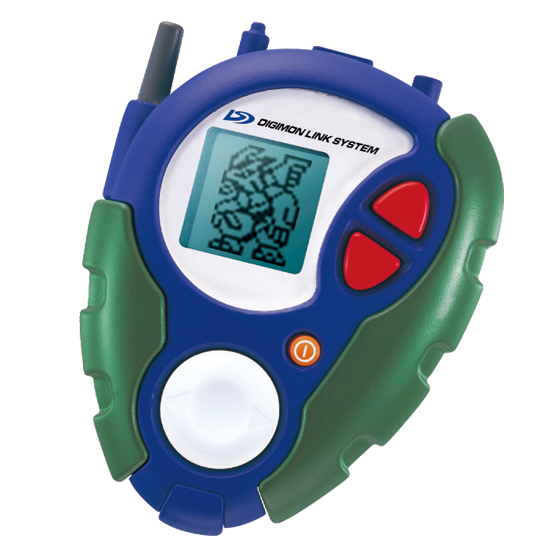
"Through fifteen years of time...The countdown to Adventure, begins now--"
May 20th, 2016. The official Premium Bandai web shop updated with a teaser page for the D-Ark Ver. 15th Digivice, which was previously leaked yesterday in an early issue of V Jump magazine. As revealed in V Jump, the first colors for the D-Ark will be Matsuda Takato (red) and Makino Ruki. (Blue) Mirroring the original D-Ark toy, accompanying trading cards are depicted in the teaser, likely for card slash functionality. The page promises a further evolution of the Ver. 15th series, with additional information scheduled for on June 21st.
A list of devices the D-Ark Ver. 15th is intended to be compatible with is not yet public. The original D-Ark was somewhat disruptive within its own time for being incompatible with the first virtual pets and Digivices, only having compatibility with the Pendulum series, Pendulum Progress, and D-3.
This Ver. 15th's tagline is an allusion to Digimon Tamers' opening theme The Biggest Dreamer, although it references a part of the lyrics not heard in its TV size version--"For a long time / I've heard the countdown / I'm prepared / Let's start now, change into zero!"
The toy is preceded by the D-3 Ver. 15th, which will be distributed next month.
March 11th, 2016. The latest color version of the D-3 Digivice Ver. 15th became available via the Premium Bandai web shop today, in a run of just 3,000 units. Like with the black and blue Ver. 15ths before it, the Paildramon Color device is being given a limited run. Based on the color scheme of Motomiya Daisuke & Ichijouji Ken's Jogress D-3, the toy goes on sale for 9,990 yen from 11:00 PM Japanese Standard Time. The finished devices will ship in July. Those that order it will receive a Paildramon illustration sheet.
The Digivice will contain more than 150 Digimon, with more than 80 being usable by the player. There are six available partner Digimon, the selection being derived from Digimon Adventure 02; Patamon, Hawkmon, V-mon, Wormmon, Armadimon, and Tailmon. Aside from the color the device appears to be identical to its predecessors, with the structure of the Paildramon Color's gameplay following the same route as the original Ver. 15th D-3. The LCD toy tours players through the world of the anime series, culminating in a final battle with Armagemon. Imperialdramon Paladin Mode will be available on this Digivice just as he will be in the preceding D-3 Ver. 15th, and by connecting it to a first generation Ver. 15th, tamers can unlock a special message.
As of March 16th, the device is sold out, with "no plans" for a continuation.
February 9th, 2016. The Premium Bandai web shop updated tonight with a surprise product in stock; the D-3 Ver. 15th Digivice Paildramon Color. As with the original D-3 Ver. 15th--which will be sent out this June--the Paildramon Color Ver. 15th will be produced in only limited quantities, fixed at 3,000 units. Preorders will open on March 11th at 11:00 AM Japanese Standard Time, and the final product will be shipped out to buyers in July 2016. The price is identical to preceding D-3 Ver.15ths, 9,990 JPY. (About $90 at present exchange rates.)
The previous twin black and blue models of D-3 sold out just six days after preorders opened. As P-Bandai only sells directly to Japanese buyers, international fans will have to go through a middleman service to purchase the Digivice.
January 11th, 2016. Bandai Fashion Net added the Digimon Adventure Agumon Fluffy Pouch (Virus Version) to the Premium Bandai web shop today, listing it at a price of 2160 JPY ($19 approximately at the current exchange rate). The limited edition plush toy, which was previously sold at Comiket 89 in December, will be available for purchase through Premium Bandai beginning January 13th, 2016, 11:00 AM Japanese Standard Time. 200 of these plushes were sold at Comiket, and a remaining 100 more will be sold online. Those not residing in Japan will have to go through a middleman service to obtain the plush toy, just as they would have for the Monzaemon Fluffy Pouch and D-3 Ver. 15th Digivice.
January 1st, 2016. The fifteenth anniversary remake of the D-3 Digivice is no longer available; all six thousand units have been ordered, and will be shipped to consumers in June 2016. The Motomiya Daisuke color D-3 sold out first, becoming unavailable on December 30th, while Ichijouji Ken's could still be ordered until today. The D-3 Ver. 15th is being produced in extremely limited quantities, possibly as a way to test the market for products beyond the original Adventure series. Along with the D-3, a reissue of the original Ver. 15th for March 2016 was simultaneously announced, but those orders closed several days earlier.
December 1st, 2015. Bandai of Japan has put out the formal launch announcement for its next line of gashapon toys, which will include a set of memorial goods in commemoration of Digimon Adventure. The Digivice collection will include nine different colors, based on the original Digivice's base colors and the eight variations used during the Chosen Children's super evolutions. There will also be a set of eleven tags with crests, comprising the original eight plus the crests of Destiny, Miracles, and Kindness. (These crests are derived from Digimon Adventure 02 and the two-part movie Hurricane Touchdown!! / Supreme Evolution!! The Golden Digimentals.) The Digivice and crest collection is currently available at select machines, and each capsule costs 300 yen. (Approximately $2.50 at the current exchange rate.)
Gashapon toys are a popular market for collectible toys in Japan, distributed randomly through blind capsule machines. While the individual capsules can range from 100 to 300 yen out of the machine, due to the difficulty of acquiring a complete set, select items in each collection can sell for much more on secondary markets. The previous set of Adventure gashapon toys was briefly previewed by actress Mimori Suzuko during the November 20th promotional livestream for Digimon Adventure tri.
Both the Tamagotchi and Digimon product packages were redesigned for the US by Bob Nenninger.
As we reach this point in the franchise's history, I find there are significant gaps in the record not addressed by the Japanese sources that would normally be regarded as authoritative. V-Tamer's Residence is precariously unaware of any LCD games not released in Japan, and NHOKO is similarly uninformed. We have our own story to tell.
From the onset, Bandai was invested in expanding its brand to a global scale. Digimon quickly found a foothold in Asia and the United States, and even when American markets would eventually contract, Bandai's audiences in China, South Korea, Hong Kong, and other countries, would continue to be a reliable consumer base for the company to cater to. In the years to come, Bandai would go so far as to cater directly to the Asian market even when Japanese sales were down, tailoring products specifically to Hong Kong, Taiwan, and South Korea.
Originally uploaded by Sarah Colledge, used with permission.
The original Digital Monster pets were exported to the United States, United Kingdom, Australia, and some parts of Asia in 1997, accompanied by promotional materials that tried to capitalize on the Tamagotchi craze by tethering the Digimon brand to it. The press brochure Zen and the Art of Digimon: The Trainer's Spiritual Guide significantly orientalized the franchise in spite of numerous cultural and name changes made to the pets, promoting the Digital Monster series with humor parodying the works of Zen masters in a chopstick-letters font. The brochure was also sprinkled with hiragana and 5-6-4 haiku poetry ("DigiMon are pure... As snow in a country... Which has no dogs") to cement its "Zen" elements, using the nonsense words おなお onao and おなもお onamoo in place of actual calligraphy to give the appearance of being authentically Zen.
Produced by public relations company The Wright Partnership Ltd., Zen and the Art of Digimon played up the pets' connection to Tamagotchi with a literal family tree. The brochure set up Digital Monster as partitioning directly off the first generation of Tamagotchi, with no production relation to Tamagotchi Angel or successive products. (Accordingly, this chart graphed Digimon as an offshoot rather than as part of Tamagotchi's development history.)
This tree lists Tamagotchi Garden as due for a UK release; Garden was ultimately canceled in the west in favor of Ocean.
How true this was is questionable; the meter used to track a Digimon's level of training has similarities to the second-gen Tamagotchi Mothra's (July 1997) Justice Meter, and Angel's (August '97) Angel Point meter. The two-pronged conductors used for Digimon's battle communications are also almost identical to those found on the Mesutchi/Osutchi generation of Tamagotchi toys, which were the first Tamagotchis to connect to one another. Considering that Digital Monster launched six months prior to Mesutchi/Osutchi, a more likely diagram is that Digimon was based on the hardware and software written for Mothra/Angel, and Mesutchi/Osutchi evolved directly from the Digital Monster pets. (No other Tamagotchi would have connector prongs throughout the brand's life, presumably due to Digimon taking over as Bandai & WiZ's multiplayer pet of choice.)
Originally uploaded by Sarah Colledge, used with permission.
Zen and the Art of Digimon is a very questionable work in terms of its relationship to the greater franchise. On one hand, it contained the first accurate translations of Digimon virtual pet profiles, the same Japanese texts that would later be used as the basis for the Digimon Reference Book. Just compare the Airdramon profile above to its Reference Book profile from 2014. But on the other hand, it also went to great lengths to censor elements of Digimon and introduce ideas not found in Japanese language materials. That same profile omitted a line in the virtual pet profile about Airdramon being close to god, and these first materials also referred to Devimon as Darkmon, and Monzaemon as Teddymon. Zen also introduced new locations and setpieces of dubious canonocity, some of which would be adopted into the packaging for the exported pets.
"The traditional method of training DigiMon was developed by the legendary DigiMonks, a group of mysterious hooded figures who inhabit a hidden monastery deep within the Far East End where they dedicate their lives to contemplation, meditation and teaching DigiMon how to beat seven shades of snot out of an opponent. The DigiMonks divide the nurturing of virtual-fighting-machines into three areas: diet, coaching and spiritual well-being."
The international pets were first advertised as DigiMon, a form of CamelCase found on several early English Digimon materials prior to the debut of Saban's anime dub. Unlike
the blister packaging used for Japan, in Asia and the United States a
box that concealed the interior pet's shape was used to contain it. Like theTamagotchi series preceding it, this was a result of the packaging artwork being redesigned by marketing illustrator Bob Nenninger.
Bandai's aim when redesigning the Tamagotchi packaging was allegedly to alleviate consumer confusion about the product, but I would approach this idea with a degree of skepticism. Bandai of Japan never tried to redesign Tamagotchi's packaging for the Angel, Garden, or Ocean products, yet the toy's era was ultimately cut short not by a lack of consumer awareness of what they were buying, but a concentrated move away from the toys as a fad.
Regardless of the redesigned packaging's origin, Digimon emulated Tamagotchi's international packaging to maintain a visible connection between the two pets. Like with the Tamagotchi pets, the front cover of the international Digital Monster packaging swung open to both show what the toy looked like and provide a description of what Digimon were. The pet's connectors were a novelty for the time, advertised as "Dock 'n Rock action," a term which may originate from Japanese promotional materials. (The first known reference to the pets as "Docks" was in the C'Mon Digimon manga, but the Japanese pets used "Battle Connect" as their slogan.)
"DIGIMON™ is the unique Digital MONSTER™ from cyberspace. Accessed from the Megalithic Mainframe, DigiMon comes to you to be hatched, raised and trained for the ultimate MONSTER MATCH--a cyber showdown between one DigiMon and another. With the exclusive Dock 'n Rock action, you link up your DigiMon with your friend's DigiMon--only one will win! Who will reign victorious? It depends on how well you raised and trained your DigiMon. Feed him well; train him thoroughly. For when the time comes for DigiMon to return to the Megalithic Mainframe, his ultimate honor is to be the strongest!"
The "Megalithic" idea was just one among several ways in which Digimon tried to capitalize on the 90's dinosaur craze. The initial western commercials for the Digital Monster pets played on the hype surrounding The Lost World: Jurassic Park, which had debuted in theaters only a few months earlier. The side effect of this was that the outside world was exposed to a divergently different version of Digimon than what was being presented back home in Japan, and the description of Digimon given above deliberately contradicted the Japanese language materials from that time. The Megalithic Mainframe itself was invented as an explanation for Digimon not dying, as the tombstone graphic normally displayed upon a Digimon's death was removed for the US, European, and Asian Digital Monsters, replaced by an image of a computer (the eponymous Mainframe).
This euphemistic return to the mainframe may have been created to prevent any so-called "Tamagotchi suicides," rumored suicides by virtual pet owners over the deaths of their pets that supposedly took place in Japan or South Korea in 1996. I've never seen any source to the rumors, but they were referred to in reputable tech publications like Next Generation magazine's October '97 issue.
The Nenninger packaging was used in Asia as well, while in Europe a mix of boxed and blister packaging (featuring the western-original
illustrations on its illustration board) was used. Even at this early stage of its development, FOX was taking a strong interest in the Digimon brand. The Monster Match-Up sweepstakes were conducted through a Fox17 news station in Tennessee, and TV commercials for the pets were produced and aired through the Fox Broadcasting Company.
The international pets changed the patterns found on each Digitama, as well as the colors of the devices themselves. Rumors from the early in the franchise's western launch found their way onto Tamagotchi fansites, pointing to several alternative names
for Digimon--"Digital Demon," "Digi Demon," and "Tama-Hawk" among them. While the
veracity of this is difficult to confirm, it's interesting that these
rumors surfaced in the first place. What kind of image were westerners
trying to impress onto the franchise? "Digital Demon" rings of late 90s Christian paranoia about demonic forces lurking in Pokémon cartridges, and invites comparison with the "Webkinz Killer" rumors of 2007.
One can only speculate on this topic, but I've noticed that the general tone of early Tamagotchi sites was ambivalent with regards to "DigiMon." Perhaps such tensions are to be expected; Digimon was an inherently masculine counterpart to Tamagotchi at the outset. One one level, it was threatening to the Tamagotchi fandom that Bandai saw a need to create a toy for a market they weren't already reaching out to. On another, there's always an underlying fear that one brand may replace another when its predecessor underperforms. (Just compare the case of Cardfight!! Vanguard and its child series Future Card Buddyfight. The early animosity from cardfighters was in part motivated by Bushiroad seemingly putting more into marketing Buddyfight than Vanguard.)
While Digimon never reached the same overwhelming popularity as Tamagotchi, the pets proved popular enough in Australia to lead to the creation of a sixth version by Bandai Asia, in clear
purple (what the Japanese would think of as a "skeleton" plastic) and
grey. Even today, almost no one in Japan is aware of V6. The fukei used for the Ver. 6 was identical to that used for Pendulum 1.0: Nature Spirits,
and the game architecture similar to the Ver. 5 Digital Monster, while the actual Digimon present were based on Nature Spirits sans the Ultimate/Mega (US) level. Its Group L/S Rank
Perfect was Tonosama Gekomon ("Shogun" Gekomon due to the western
release) with Gekomon as its Numemon equivalent. Being exclusive to one country, the Version 6 has become highly prized by collectors, auctioning for $300 to $350 where most Digital Monster pets in 2015 only sell for $60~80 out of box.
Success came with its own challenges. Bootleg Digital Monster pets began to emerge, reverse-engineered from the original models put out to the public. These bootlegs would often have buggy pixels, poorly configured contrast settings, and manufacturing errors, which also served as identifiers for connoisseurs. The most noticeable mistake was found in the corners of the screen's "lock" frame, which were sharp in bootlegs but rounded in official pets.
A more real threat to Bandai's copyright was Digital Monster 6 on the Game Boy Color, an unlicensed and unofficial game created by Hong Kong developer Best Rich. DM6 was a direct translation of the virtual pets to the GameBoy, using a specially-designed cartridge with its own set of two-pronged edge connectors capable of communicating with Digital Monster and Pendulum pets as if it were any other device. In adapting the virtual pets for the Game Boy, the developers of Digital Monster 6 seemed to follow the same trains of thought as Bandai's staff.
Just like in Ver. S and WS, tamers could purchase, hatch, nickname, and raise several Digimon at once from a central shop system, up to eight Digimon simultaneously. And like in those games, the player could also move the clock forward manually to speed up the raising process, and adjust the speed at which time passed generally. One giveaway to its unlicensed status was the use of meat and sweets as meal items rather than meat and protein, and that the Digimon resided in a house rather than a cage. The other features of training, flushing poop, and evolution were spot-on.
It's little wonder that nothing of this sort ever manifested officially, as Bandai was actively competing against the Game Boy during the time frame when an official product of this kind could flourish. Any remnants of DM6 are lost to time. No ROM image of the bootleg has emerged on the web. In light of specific prohibition policies against allowing the sale of bootlegs on popular e-shopping services like eBay and Amazon, the only way to buy it would be through a flea market or a seller from Hong Kong. Even then, the question remains of being able to actually bring an item that violates international copyright back into the borders of one's own country. The world has been put under many more locks and keys since these bootlegs were first created.
Unlike in Japan, no D-1 tournaments would ever be organized in the United States. South Korea, China, and Hong Kong were all incorporated into the Grand Prix at least by 2002, but any earlier tournaments are undocumented. Digimon was instead marketed as the next Tamagotchi fad, something played between friends but being deliberately short-lived, and certainly seemed to meet Bandai's short-term goals.
The Pendulum series was also never brought over to English-speaking countries. Instead a two-year gap followed until the launch of the Digimon: Digital Monsters anime dub on the Fox Kids network. Aside from future handheld and console games, another proper virtual pet would never again be distributed in the west. The presence of the anime dub made Digivice toys explosively popular, completely supplanting the pets in the popular imagination. Asia was on the opposite end of the spectrum, with Hong Kong and Singapore enjoying early releases of Japanese pets, and even their own Asia-original pets through 2002, though these did come among Asian Digivice releases.
Left: American poster for Digimon: Digital Monsters. Right: Japanese poster for Digimon Adventure.
As to the quality of the Saban dub, modern fans coming into Digimon now are likely confused by the claims that it was extremely accurate to the original. This is a somewhat complicated situation. For years, Digital Monsters was held up as one of the most accurate anime dubs of all time, and one of the series least ashamed of its Japanese origins. This was true for 1999, but the Saban dub is better remembered in the same way that we remember Don't Ask Don't Tell--"fair for its day." I've seen the differences between Toei's Digimon Adventure and Saban's Digimon: Digital Monsters expressed using their series' respective posters (seen above), an analogy I'm inclined to agree with. The characters, core plot, and scenes are generally similar, but the American dub was saturated with exaggerated portrayals that changed the chosen children from complex personalities caught up in difficult circumstance to a Looney Toons DigiDestined focused more on cracking jokes than growing as individuals.
This isn't the place for an exhaustive rundown, but try comparing just one character. In Adventure, Kido Jo is struggling not to crack under the pressures of living up to his father's expectations to become a doctor (and how much of those expectations are actually his own), being the eldest child responsible for protecting the rest of the group, and keeping his promises to the various friends he makes in the series. His partner Gomamon always speaks what's on Jo's mind, teaching him to be forthright with his feelings and follow his heart. In Saban's Digital Monsters, Joe Kido is a chronically-ill complainer with hyperactive asthma, allergies to every new thing he encounters, and is a general Hall Monitor-type. His partner Gomamon constantly clashes with him, making him lighten up and learn to not worry about everything. Kido Jo's crest is Sincerity, Joe Kido's crest is Reliability.
The Saban dub did less cuts than other anime for the time (it did do cuts; things like the end of episode 42 being moved to the beginning of 43, removing chopsticks, bath scenes being deleted, etc.) and its character name changes were nowhere near the level of contemporary Pokémon. To its benefit the dub--while quite shy of the fact at first--eventually admitted that the series was set in Japan, and conceded to naming the major landmarks of Odaiba. There are Adventure fans that grew up watching the dub, then later traveled to Japan as adults and visited the real-world sites of its most famous scenes. Even so, American viewers should be aware that the outside world gives very strange looks to our dub apologists. Of all the international dubs of Digimon Adventure, the American dub was the least faithful, and the changes made come off as both hypocritical and at odds with our alleged American values. Name changes are the most glaring; while Tai, Matt, T.K., and Kari, are all presented in the dub as nicknames for Taichi, Yamato, Takeru, and Hikari, functionally these names are treated as if the originals never existed. The United States is supposed to be the most culturally diverse and accepting nation in the world, yet while xenophobic Japan wouldn't shy away from portraying Li Xiaochun and her primarily Chinese family in Tamers, we're still driven to turn Izumi Koushirou into Izzy and replace the soundtrack with Kim Wilde's Kids in America. It seems no one on the dubbing staff realized there were children in the US with Japanese names. The fact that this practice has continued well into 2015 is both frustrating and shameful.
The original soundtrack, as well as the now-iconic opening and ending themes Butter-fly and I Wish were all cut for the American release in favor an approximately four-track original OST, later adding Hey Digimon as an insert. The dub opening theme has infamously become the one of the only things popular American culture remembers about Digimon, the other being the incomprehensible March 2000 film. Note that making such dramatic changes was not the uniform practice globally, as the Portuguese edition of Adventure dubbed both Butter-fly and I Wish (though the lyrics had no real relation to the original), and other international dubs were more faithful to the original script. The European Spanish dub was based on the Japanese Adventure script, as were the German, Portuguese, Arabic, and Latin American dubs, whereas the French, Swedish, Hungarian, and Polish dubs were based on Saban's dub script. Most of the international dubs, with the exception the Arabic dub, changed the names of the children to match the American ones, a decision which was mandated by Toei. Ironically, it seems American names were more acceptable than Japanese ones in countries where one would never otherwise encounter a Matt or a Joe.
The US Digivice hit across a string of unknown dates in 1999, in three waves: 1.0, 2.0, and 2.5. On 1.0 all partners except Agumon and Gabumon were capped at Perfect/Ultimate (US) level, while 2.0 and on added Ultimate/Mega level evolutions for all partners. Like with their Japanese counterparts, these were pedometer devices which progressed through a series of areas (seven in total) by counting the steps made through either walking, or shaking the device. The sprites on these toys were greatly truncated from their Japanese counterparts, reverting to 16x16 but using completely original designs rather than simply lifting their sprites from the Digital Monster series.
Battle was somewhat different. Digimon had Life and Attack stats, and
every round the Digimon would evolve if it was able to do so,
increasing its stats. Area bosses were invulnerable to
Child/Rookie-level Digimon, and were encountered by clearing the number
of steps needed to progress. The player could only revisit preceding
areas after clearing the entire game. In battle, successful evolution
depended on a count feature just like in the Pendulum series' attack
system, but using actual attacks depended on rapidly mashing the A
button rather than on shaking the toy. When connecting to other devices,
the Digivice would use either its own American Digivice rules (only versus other
US Digivices) or Digital Monster rules (for everything else). The Vaccine/Virus/Data triangle did not exist on American
toys, and all Asian-American Digivices could connect with the Digital Monster series, Pendulum, and Japanese Digivice (and later the Japanese D-3). Its compatibility with the Analyzer remains undocumented.
Unlike the Japanese Digivice, the Asian-American
variants did not have Tailmon/Gatomon (US) included. The AA devices
also didn't have any of the vestigial meal items. Both graphically and in gameplay terms the US/Asia Digivice was a downgrade from the Japanese Digivice and Pendulum series, as it removed the strategic in-game battle system of the Japanese toys, and didn't have any of the careful management aspects of the Pendulum series. Rather than the meticulously balanced count system found in Pendulum, on the US Digivice there was no measure of rhythm, only speed and button mashing. On the other hand, this Digivice at the very least didn't revert to Digital Monster rules when connecting to other Digivices.
Regardless of how we couch it, the question of gameplay will always be subjective. When the two are compared in a vacuum, both the Pendulum count system and the Digivice count system require a level of kinetic skill to play well, the Digivice just asks every tamer to have a uniform ability to hit the same RPM while the Pendulum demands something different depending on which version and Digimon you're using.
The Asian territories this Digivice was distributed in include Thailand, Malaysia, and Taiwan. (Whether or not it was distributed in mainland China is unclear.) Although the various versions came in a myriad number of colors, there were no gameplay differences between them except by version. The Ver. 1 came in orange, dark blue, red, green, and light blue, while the 2.0 came a clear plastic version, black, purple, yellow, and a glow-in-the-dark white. The 2.5 came in clear purple and metallic grey. The lack of product information and clear version identification outside of the Digivice's internal menus makes tracking down all of the colors difficult, so this list may not be exhaustive.
One of the small marvels of Digimon's history is that it somehow survived while Tamagotchi died off. 36 million Tamas were sold in from 1996 to 1997, nearly half of the franchise's 80 million
life-to-date sales from 1996 to 2013. By 1998 the Tamagotchi craze had
gone the way of the pet rock, with the holiday-themed Santaclautchi as the eleventh and final Tama in the original series. Yet at this time Digimon was a gold mine
for Bandai, and for a period through 2000 the company was unable to end
its international toyline because of the strong public demand. The sudden failure of Tamagotchi in March 1998 severely hurt Bandai, as they overproduced for a market that no one quite realized was disenchanted with the Tama fad, and made the company cautious about future investments. In 1998 another recently launched joint Bandai-WiZ franchise, Magical Witches, failed to penetrate. Having come at the tail end of the virtual pet craze when the world was finally forgetting about Dogz, Galapagos, Fin Fin, and Tamagotchi itself, Witches ultimately only survived through its setting Witchelny, a parallel Digital World from which Wizarmon, Piccolomon, and some later Digimon like Witchmon were all said to originate. Tamagotchi was consigned to a similar fate until the mid 2000s, living on through Nanimon, but the mystery is that Digimon managed to persevere for so much longer.
Given the global success of the various Digimon anime series--even if short-lived--and the Digivice toys, it seems clear that Digimon outliving its parent franchise is partially owed to it moving away from the very elements of nurturing and raising that longtime fans lament the loss of. This isn't uniformly true, as later years demonstrate the series thriving as a virtual pet even when other products perform poorly, but building up an audience through the anime series and quest-based Digivice toys made it possible for Digimon to acquire a consumer base that wouldn't otherwise be interested in it. The franchise was at its strongest when it appealed to multiple intersecting interests that gave it a strongly diversified audience.
After it first took off internationally, Digimon could no longer remain a strictly Japanese franchise. The future would see increasingly close product launches in multiple countries annually, and over time Bandai of Japan would come to absorb some of Asia's Digimon terminology into the main franchise. With Bandai and Toei fully aware of the international power Digimon was beginning to muster, the year 2000's Digimon Adventure 02 would see the franchise presenting itself as a globalized space for children of all nationalities.
Next: The 2000 Grand Prix and the Year of the Digivice